16 November 2026
How Much Does a Website Cost in Kenya?
Pricing · Websites · Kenya
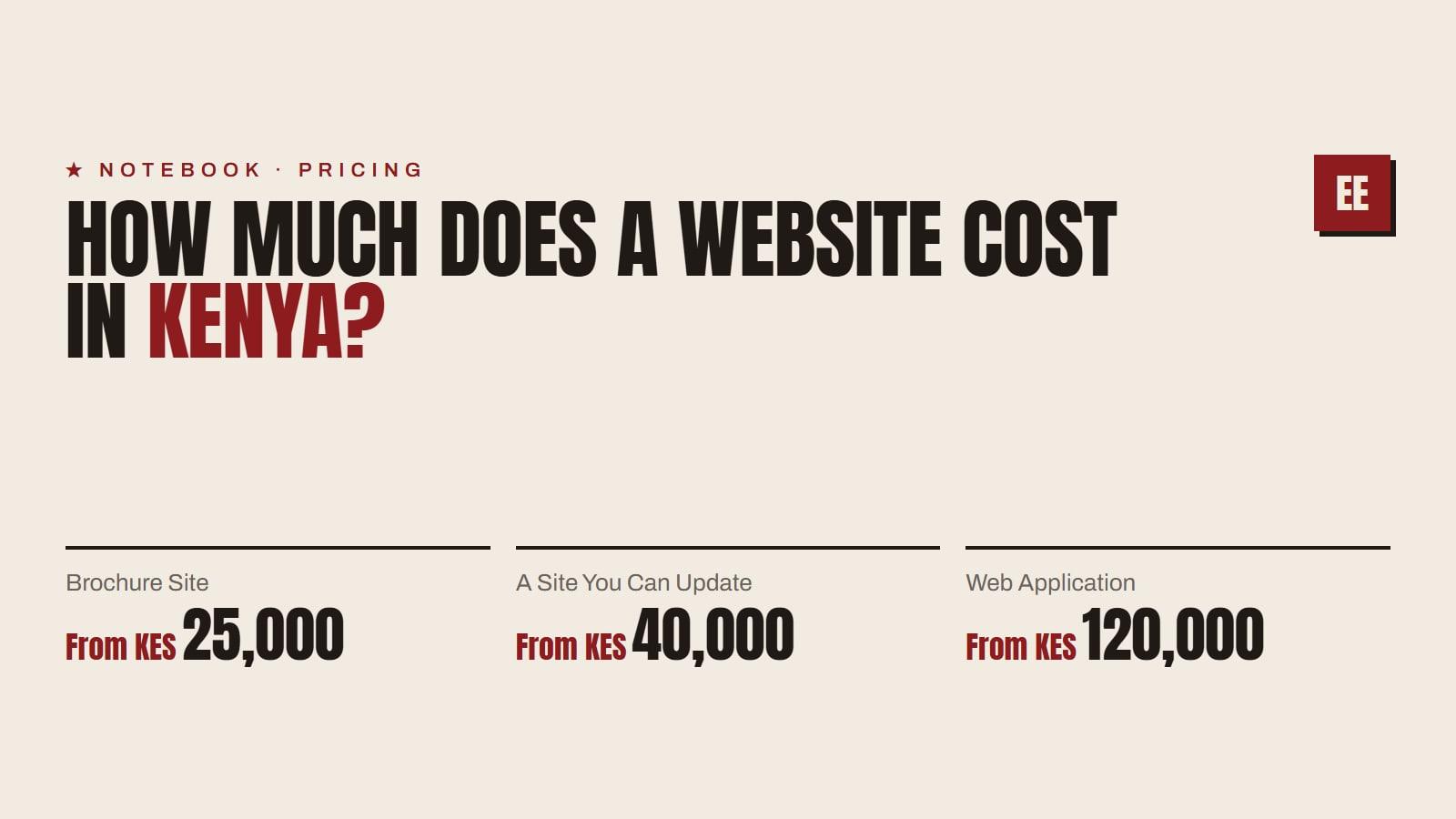
A simple website in Kenya costs from about KES 25,000 to build, a site you can update yourself from about KES 40,000, and a web application from about KES 120,000. Those are my prices, and they sit within the ordinary range for the Kenyan market. On top of the build you will pay every year for a domain and hosting, which for a small site comes to a few thousand shillings.
I'm asked this more often than any other question, usually in the first message and usually before I know anything about the project. It's a fair thing to want to know. The honest answer is that the price depends far more on what the website has to do than on how many pages it has, so what follows is how I would think about it if I were the one paying.
What Each Kind of Site Costs
- A brochure site, from KES 25,000. A handful of pages that explain what you do and how to reach you. You send me the words and photographs, I build it, and changes after launch come back through me. Most small businesses starting out need nothing more.
- A site you can update yourself, from KES 40,000. The same, with an admin area so you can add news, stories, products or events without calling me. It suits anyone whose information changes every month, and it's what I built for Cheche Za Nuru Foundation.
- A web application, from KES 120,000. Anything where people log in, records are kept or money changes hands, such as booking systems, member portals, case management and dashboards. The price rises with the number of different kinds of user and the number of other systems it has to talk to.
These are starting points rather than fixed prices. Two sites in the same band can differ by a fair amount, for reasons I'll come to.
What It Costs to Keep a Website Running
The build is a one-off. A few costs come round every year, and they are the ones people tend to forget when comparing quotes.
- The domain. A .co.ke address costs about KES 1,000 a year from Kenyan registrars. Make sure it is registered in your name rather than your developer's, a point I've written about before.
- Hosting. Basic shared hosting starts from a few hundred shillings a month. A web application with a database usually needs more, and the bill grows with the number of people using it.
- Maintenance. Updates, fixes and small changes after launch. Some developers charge a monthly retainer and others bill by the hour. Ask which before you sign.
What Pushes the Price Up
In my experience the number of pages is seldom what makes a website expensive. These are the things that do.
- Content that isn't ready. If I'm waiting weeks for text and photographs, or writing them myself, the project takes longer and costs more.
- Payments. Taking M-Pesa is straightforward enough. Matching every payment to an order or an invoice, so that your records add up at the end of the month, is real work.
- Logins and roles. Each kind of user who sees something different adds to the work of designing and testing it.
- Connecting to other systems. Linking the site to an accounting package or an SMS service is a small project of its own every time.
- Changing direction halfway. It happens to everyone, and it is the most expensive line on any invoice.
Why Quotes Vary So Much
Ask five developers in Nairobi for a quote and you will very likely get five very different numbers. I don't think that is always a sign that someone is overcharging. Some are quoting a template with your logo on it and others a site built from scratch. Some include hosting and a year of support, while others stop on the day the site goes live. Comparing quotes only works once you know what each one includes, and it is perfectly reasonable to ask.
How to Get a Fair Quote
Describe what the site has to do, rather than only how it should look, and say who will use it. Mention the budget you have in mind, even roughly. A developer who knows the budget can tell you what it will buy, which is far more useful than a quote for something you can't afford. Then ask everyone the same handful of questions, so that the answers can be compared.
If you would like a number for your own project, the quotation form is the quickest way to get one, and the project brief helps if you are still working out what you need.